

What Is Mutual Funds? | Mutual Funds | Advantage of Mutual Fund in India | How To Invest In Mutual Funds Online?
What Is Mutual Funds. How To Invest Online. Detailed Analysis

Mutual Funds is such an investment medium where many investors together deposit money to earn good returns from their capital over a period of time. The corpus of this funds is managed by an investment professional known as Fund Manager or Portfolio Manager.
The job of that fund manager/ portfolio manager is to collect all the funds and invest them in Bonds, Stocks, Gold, Money Market Instrument and other assets to provide potential returns to the investors .
We can understand it in another way also, a fund manager is a person or organization that collects money from many investors. After creating a portfolio of some of the best selected bonds, stocks or other assets, all the money collected from the investors is invested in it so that the investors can get good returns from it, apart from this the fund manager also check the performance of all those selected bonds and shares.
Because if a selected stock bond is giving less return than the traditional investment, then it can be replaced by another good stock.
Table of Contents
Main Objective Of Mutual Funds
This whole process has only one main objective, even if any bond or stock included in the formed portfolio does not perform well, then the rest of the shares or bonds included in that portfolio balance the portfolio to make good profit.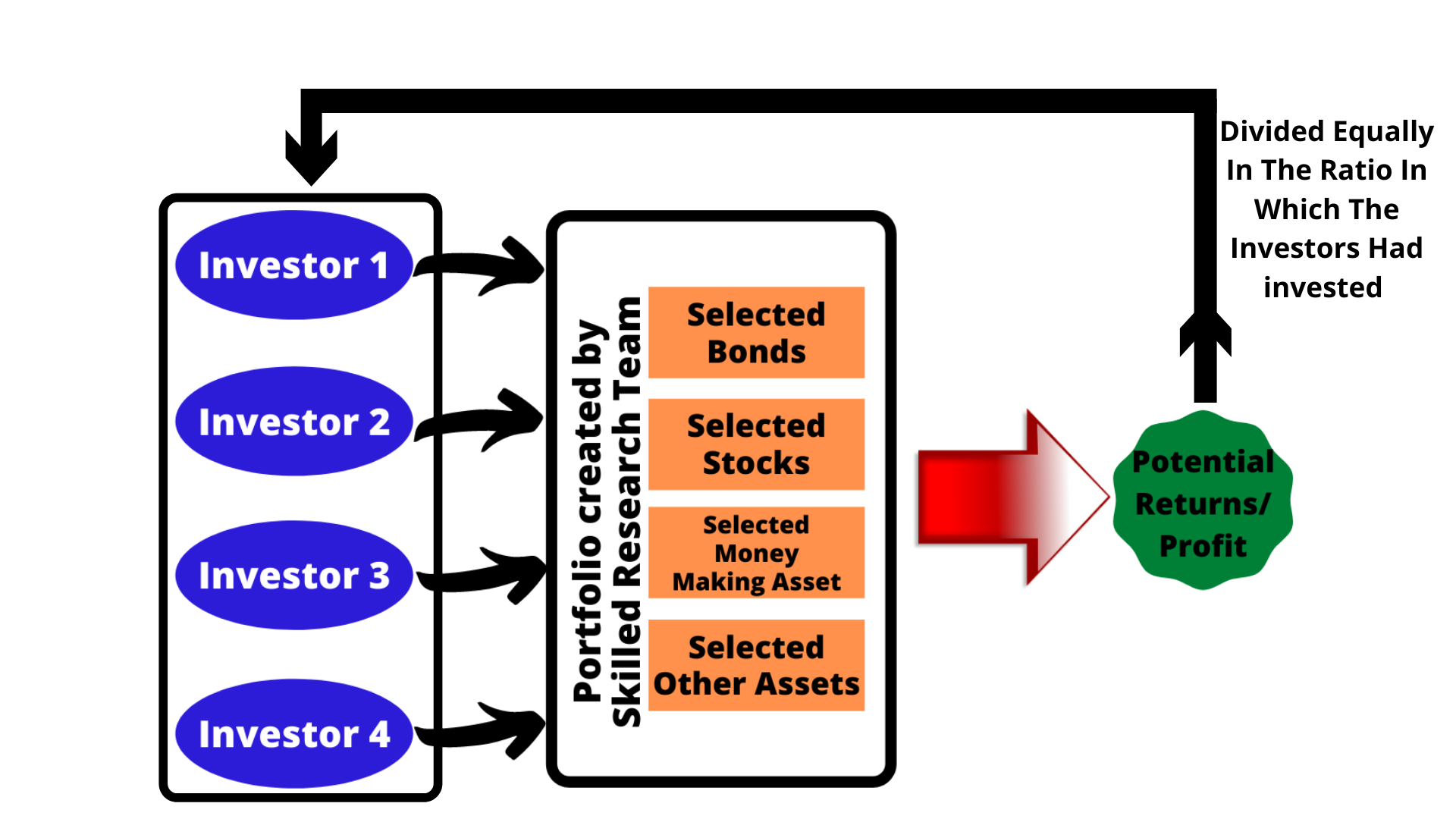
Why Mutual Funds Are Needed
Why MF(Mutual Fund) is necessary and how MF helps in our financial growth. MFs are a modern way to increase your capital.
Since ancient times, people used different methods to keep their money safe. Nowadays people deposit money in the form of funds in the bank, in LIC or in any other government scheme to keep their money safe. But these schemes can keep your money safe but cannot help you in financial growth.
Today, if we compare the return from Govt schemes and with the inflation rate, then you will see that it cannot help you at all in achieving your financial goal, we understand it by an example.
If we compare the benefits from the government scheme with today’s inflation rate, we will see that today’s inflation rate is about 6% per annum and the benefit from the scheme is about 4% per annum. We can understand this in another way, suppose we put 100 rupees in a scheme for 10 years, if we calculate the profit from it, if we calculate the compound interest also, then after 10 years the cost of that 100 rupees will be 148 rupees. And if we calculate with inflation rate, then what is 100 rupees today, after 10 years we will have to spend 100(1+6/100)=160 rupees for the same thing.
From this we can understand that after 10 years our capital which was 100 rupees which after 10 years has become 100 48 = 148 and comparing the inflation rate, then the thing which had to cost 100 rupees earlier, after 10 years 100 60 = 160/- will have to be spent
So total profit = total income – total expenses
148-160=-12/-
It means we are not saving money we are giving money from our pocket
How MF Helps Us In Financial Growth
Each person invests money in different schemes, some in shares, some in bonds or any other money making assets for financial growth for the future of himself and his family. But investing money in shares, bonds or any other asset requires a lot of research, this process is a bit time consuming process and if you choose the wrong shares then it can hurt your wealth.
That’s why we need a right research and right choice.
Mutual Funds are a great choice in which the fund manager helps us in our financial growth by building a money making portfolio with the right research and observation by their skilled professional team. A good portfolio manager / fund manager gives us a return of at least 10% per annum. All these fund managers work under SEBI. That’s why the government is also promoting it
We can understand this concept of mutual funds with an example.
Let’s say you have bought a private jet. Now you have two options to fly it.
- First, learn to operate it yourself, get all the information about it, know about its smallest things.
- The second is that you hire a skilled pilot who can safely take you to your destination.
Which of these methods would you use? Of course you will follow the 2nd method
You know that even if there is a minor mistake in your research, then you may have to suffer a lot for it and you may have to pay a huge price.
Similarly Mutual Fund also works on same concept you have deposited your money with a skilled professional team and they give you a good earning through their exact research and knowledge
Keypoint
- Professional Management : Fund manager/ portfolio manager do the research for you to achieve your financial goals
- Diversification: Risk Free Investment,
- Affordability: We get it in the lowest rates for initial investment
- You don’t need to do research on Stocks/ Bonds on your own behalf.
Types Of Mutual Funds(MF):
Although there are many types of mutual funds. But we’ll discuss them only about those types which are useful or necessary to know about them.
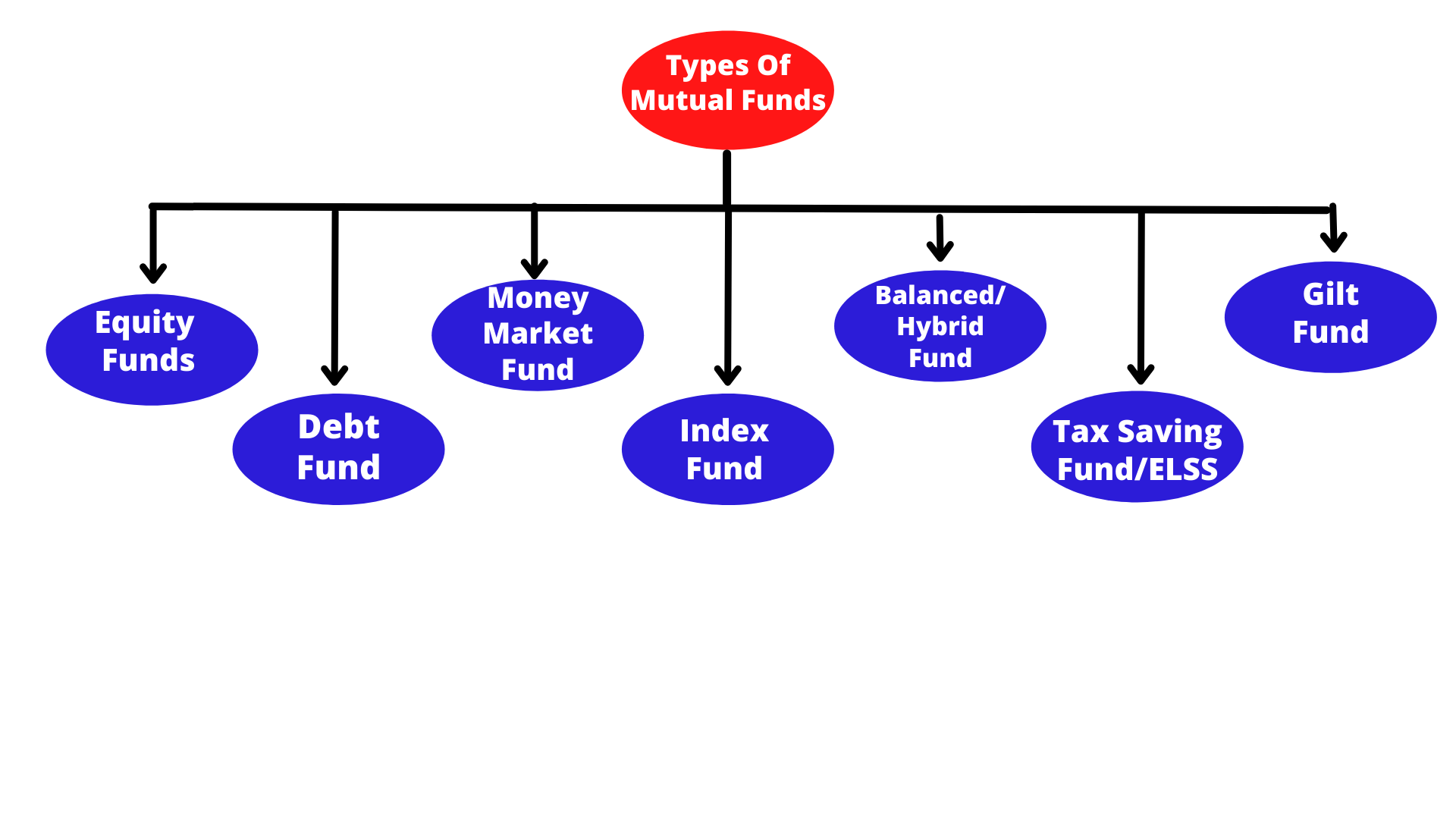
We Will Discuss About All These Types One By One.
1.Equity Funds
These are funds that invest in equity shares/ shares of companies related to the share market . They are considered High Risk Funds. High Risk means those funds also returns high returns and these funds also carry risk.
They are categorized by their market cap.
- Large Cap: Large cap companies have market caps of Rs.20000 crores or more
- Small Cap: small cap companies are those that have a market cap of less than Rs.5000 crores.
- Mid Cap: Whose market cap is above Rs.5000 crores and less than Rs.20000 crore
2. Debt Funds
These funds are also known as Fixed Income Fund Or Bond Fund. In this, the Rate of Interest to be received on the capital and of the investors and maturity period is fixed in pre-decicded. The fundamental reason for investing in debt fund is to earn a steady interest income and capital growth.
3.Money Market Funds ( MMF )
MMF invests only in short term instruments like US Treasury bills and commercial papers. Money Market Funds are short term debt funds. They invest in various money market instruments and try to deliver good returns over a period of up to one year while maintaining a high level of liquidity.The average maturity of money market fund/instrument is one year.Money Market Fund is managed by paying income in the form of dividends to the investors through liquid investments to maintain a stable asset value of the funds.
4.INDEX Mutual Funds
Index mutual fund invests in stocks that mimic stock market indices like NSE / NIFTY, BSE / SENSEX etc. They are passively managed funds which means that the fund manager invests in the securities present in the underlying index in the same proportion and does not change the portfolio structure. Theses funds try to deliver returns comparable to the index they track.
5. Balanced / Hybrid Funds
Balanced funds, also known as hybrid funds, are one of its classes that contain a bond (debt) component and a stock (equity) component in a specific ratio in a single portfolio. These mutual funds help investors to diversify their portfolio by investing in asset classes such as equity and debt. Generally, hybrid mutual funds stick to a relatively fixed mix of bonds and stocks.
6. Tax Saving Fund / ELSS
ELSS (Equity Linked Savings Scheme) is an open-ended equity mutual fund that primarily invests in equity and equity-related products. They are a special category among mutual funds that qualify for tax deduction under Section 80C of the Income Tax Act, 1961. As a result, they are known as Tax Saving Mutual Funds.
ELSS Mutual Funds provide an opportunity to earn reasonable returns and save tax. These funds invest at least 80% of the scheme’s assets in equities. Hence, the return you can earn on them is directly linked to the performance of the stock market. This can be a suitable option if you want to invest for long-term goals like building a retirement corpus or buying a new home.
7. Gilt Fund
Gilts invest only in bonds and fixed interest-bearing securities issued by the state and central governments. These investments are made in assets of different maturities. The money is invested with the government, so these funds are said to have minimal risk.
 English
 Arabic
 French
 Hindi
Hindi Punjabi
 Russian
 Spanish
 Tamil
Tamil Telugu
[…] What Is Mutual Funds? | Mutual Funds | Advantage of Mutual Fund in India | How To Invest In Mutual … […]
[…] Index mutual fund invests in stocks that mimic stock market indices like NSE / NIFTY, BSE / SENSEX etc. They are passively managed funds which means that the fund manager invests in the securities present in the underlying index in the same proportion and does not change the portfolio structure. Theses funds try to deliver returns comparable to the index they track. for more detail click here mutual fund […]